The 200 People Who Actually Matter: How to Build a Career That Doesn't Need to Go Viral
The 200 People Who Actually Matter: How to Build a Career That Doesn't Need to Go Viral
Let's start with an honest question: when was the last time going viral actually changed a working artist's life in a lasting way?
Not the story we tell about it. Not the fantasy version. The real version — where the views spike, the follower count jumps, and then... most of those people are gone within two weeks because they were there for the moment, not for you.
Viral moments are real. They can open doors. They can introduce you to people who wouldn't have found you otherwise. But they are not a career. They are a weather event. And building your entire creative livelihood around the hope of the next weather event is one of the most exhausting ways to live.
There's another way. It's slower, less dramatic, and significantly less likely to get you featured in a think piece about the creator economy. But it's also the approach that actually sustains careers over time, and it starts with a number that might surprise you.
The Power of a Small, Real Audience
Kevin Kelly's famous essay introduced the concept of "1,000 True Fans" — the idea that a creator who has a thousand people willing to spend $100 a year on their work has a $100,000 income without needing mass fame. The math has been updated and debated plenty since then, but the underlying principle holds: depth of connection beats breadth of exposure every single time when it comes to sustainability.
For many independent artists in the US — musicians playing regional circuits, visual artists selling through their own channels, performers building local followings, writers with dedicated newsletter readers — the real number might be even smaller than a thousand. It might be two hundred. It might be fifty.
Fifty people who buy every release, attend every show, share your work because they genuinely believe in it, and stick around through the quiet years? That's not a small thing. That's the foundation of an actual career.
What Algorithm Dependence Actually Costs You
The psychological toll of building your creative identity around platform performance is something the industry doesn't talk about enough — probably because the platforms themselves have a vested interest in keeping you anxious and refreshing.
Here's what it looks like in practice: You make something you're genuinely proud of. You post it. You spend the next 48 hours watching the numbers, adjusting your caption, wondering if you should have posted at a different time, comparing your reach to someone else's, and slowly allowing the metric to become your primary measure of whether the work mattered.
That's not a creative life. That's a performance review with an audience of strangers who might not even be in your target market.
The artists who maintain both their sanity and their creative integrity over the long haul tend to be the ones who deliberately decouple their sense of the work's value from its algorithmic performance. They use the platforms as tools — distribution channels, not validation machines.
Finding Your People Without Chasing Everyone
So how do you actually build a real audience when the dominant cultural message is that visibility equals value?
Get specific about who you're for. The biggest mistake artists make when trying to grow an audience is trying to appeal to everyone. It produces work that's sanded down to its blandest form and connects with nobody deeply. The more specific you are about who your work is actually for — not demographically, but emotionally and aesthetically — the more likely those people are to find you and stay.
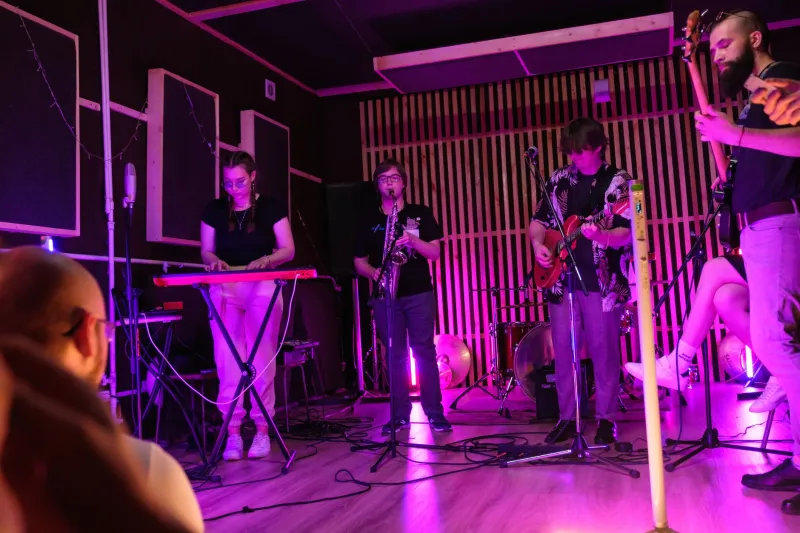
Show up consistently in smaller rooms. In music, this might mean the 80-person venue every three months rather than the 800-person venue once and never again. In visual art, it might mean the local gallery show, the community art fair, the monthly market. In writing, it might mean the newsletter that goes out every two weeks without fail. Consistency in smaller contexts builds trust in a way that sporadic big moments never can.
Invest in the relationships, not just the reach. Reply to the person who comments thoughtfully. Remember the names of the people who come to every show. Answer the email from the fan who says your work changed something for them. These interactions feel small, but they're the actual connective tissue of a sustainable creative career. The person you take five minutes for today might be the one who buys your work, recommends you to a venue, or connects you to an opportunity three years from now.
Diversify your revenue without diversifying your identity. Many working American artists support their practice through a combination of streams — licensing, teaching, commissions, merchandise, live performance, Patreon, and yes, occasional platform revenue. The goal is to build a structure where no single stream is so dominant that losing it collapses everything. But the through-line across all of it should still feel like you, not like a brand pivot every time the market shifts.
The Long Relationship vs. The One-Night Stand
Viral moments are one-night stands. They're exciting, they make a great story, and they don't call you back.
A core audience is a long relationship. It requires showing up even when you don't feel like it. It requires honesty and consistency and the occasional admission that you're figuring things out. It requires you to care about the people on the other side of the work as actual human beings rather than as data points in a dashboard.
But long relationships are also what sustain you. They're what give you the room to take creative risks, to have a bad quarter without losing everything, to grow and change without starting over from scratch every time.
The 200 people who actually know your work, who actually show up, who actually tell their friends — they're worth more than 200,000 passive followers who scrolled past you on a Tuesday afternoon and forgot you existed by Wednesday.
Build for them. The rest is noise.